Abstract
-
 01
Background and challenge
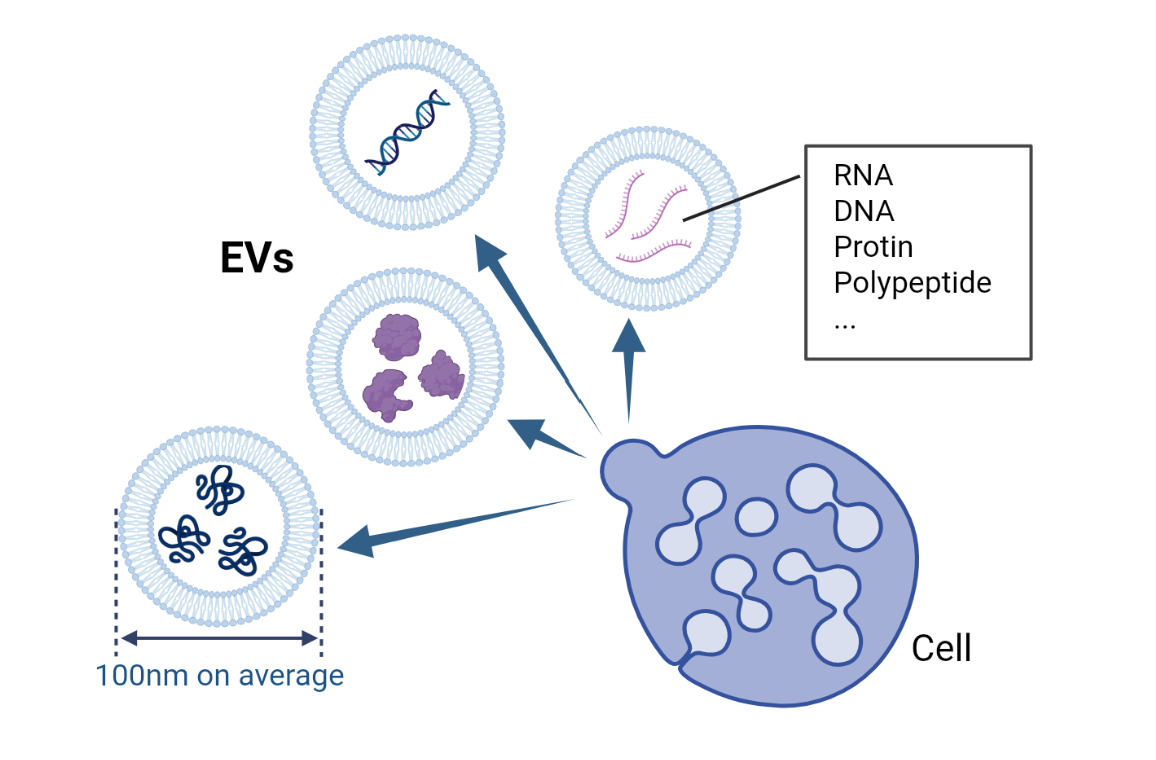
Extracellular vesicles (EVs) reflect the state of the secreting cell and have attracted attention as potential biomarkers for disease diagnosis. To analyze the information inside EVs, the lipid bilayer must be disrupted; what matters, however, is not only which molecules are inside but also which EV carries them.
Bulk assays such as surfactant treatment destroy all vesicles simultaneously, so this origin information is lost. DNA nanostructures offer an alternative physical approach, but pre-assembled structures are “always active” and disrupt membranes indiscriminately—unable to distinguish target EVs from non-target vesicles.
Our Goal A physical membrane disruption system that becomes active only near the target EV.
Project → -
02
Approach
We propose lipid membrane disruption using DNA Bundles assembled in situ by Bundled HCR. A trigger near the target EV starts the reaction (Step 1), a cholesterol-modified DNA Bundle elongates (Step 2), and it anchors to and disrupts the lipid membrane (Step 3). Because the system becomes active only near the target EV, origin information is preserved and off-target effects are minimized.
This Project To establish a proof of concept, we demonstrated Steps 2 and 3.
Project → -
03
Our Design: Bundled HCR
While conventional HCR yields a single long DNA duplex, our Bundled HCR generates a long, thick DNA Bundle. An active seed opens six types of Double-Hairpin DNAs (H1–H6) in a fixed, repeated order, so that multiple strands elongate together. By changing the seed design and the number of hairpin types, DNA Bundles with any number of helices can be assembled.
Design → -
04
Simulation
We used a 2D coarse-grained simulation and a 3D reduced free-energy model to identify which DNA Bundles can open a pore in a membrane, and to assess whether our Bundled HCR design is thermodynamically feasible.
Results Stiffer DNA Bundles were consistently associated with local pore formation, and the favorable linker length depends on vesicle size (short for R = 50 nm, long for R = 200 nm). A design target of about 12 helices per DNA Bundle was estimated, and every designed Bundled HCR step has a negative ΔG.
Simulation → -
 05
Experiment
We performed two experiments: one tested whether Bundled HCR proceeds, using a minimal 6-Helix DNA Bundle (6HB) design; the other tested whether cholesterol-modified 12- and 13-Helix DNA Bundles, chosen from our simulation results, anchor to lipid membranes.
Results DNA Bundles elongated by Bundled HCR (agarose gel and AFM), and DNA Bundles bound to the lipid membranes of giant unilamellar vesicles (GUVs) through cholesterol modification.
Experiment → -
 06
Discussion
Conclusion The design basis for a Bundled HCR-driven, membrane-disrupting DNA machine is in place. The next step is to demonstrate membrane disruption itself.
Future We will make the seed turn on only near the target EV by combining molecular recognition on the EV surface with strand displacement. Cell-free cancer-associated miRNAs could also serve as triggers, extending the system toward living cells.
Discussion →